Black hammer striking a cracked solar panel icon on white background

TPO Roofing in Springfield, Ohio

TPO, short for thermoplastic polyolefin, has become one of the most popular roofing membranes for commercial and low-slope buildings. It is a single-ply sheet, usually white or light gray, that is installed in wide rolls and joined with heat-welded seams. Property owners like it because it can be a cost-effective way to cover a large flat roof, because its reflective surface can help reduce heat absorption, and because seams that are welded rather than glued create a strong, continuous barrier. Estep Roofing LLC lists TPO roofing among our commercial roofing capabilities and installs it for businesses in Springfield, Clark County, and the surrounding area. Call (937) 206-5160 to talk about whether TPO fits your building.

How TPO Roofing Works

A TPO roof is a membrane system. Over the roof deck, a layer of insulation is installed, and the membrane is placed on top. The membrane can be mechanically fastened with screws and plates, fully adhered with adhesive, or ballasted in some situations, and the choice depends on the building. Seams are welded with hot air, fusing neighboring sheets into a single watertight surface. Flashing at walls, curbs, and penetrations is also welded or sealed. Because the roof is a continuous membrane, the quality of the welds and the details at edges and penetrations determine how well it performs.

Advantages of TPO

  • Reflective surface that can reduce heat absorption
  • Heat-welded seams that create a strong, continuous barrier
  • Wide rolls that reduce the number of seams
  • Flexibility that accommodates temperature changes and building movement
  • A cost-effective option for large flat and low-slope roofs
  • Resistance to common roof issues such as mold and algae growth in many conditions
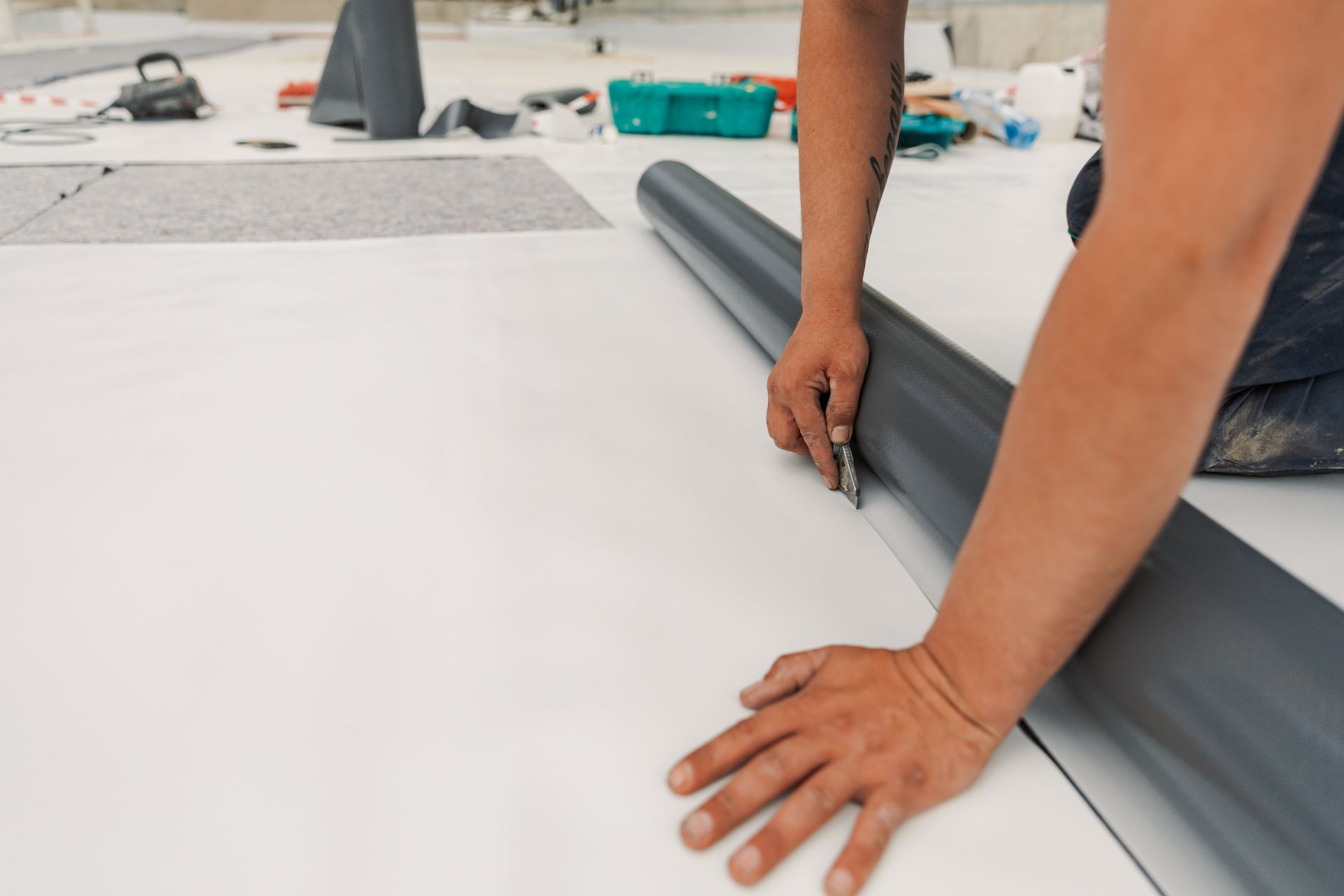
Worker specialized in mounting PVC membranes, TPO in the process of installing a water resistant system

Where TPO Is a Good Fit

TPO is widely used on retail buildings, offices, warehouses, schools, restaurants, apartment buildings, and other commercial properties with flat or low-slope roofs. It can also be used on residential low-slope sections. If you are considering a replacement and want to compare materials, ask us about rubber roofing as well. Each has its strengths, and the best choice depends on your building.

TPO Installation Quality Matters

TPO membranes vary in quality, and installation technique matters as much as the material. Seams must be welded properly, flashing details must be done carefully, and the roof must drain. We pay close attention to preparation, to the way the membrane is attached, and to details at edges, drains, and penetrations. A TPO roof installed well can protect your building for many years, and a rushed one can have problems early. We explain what we plan to do, so you know what to expect.

Color, Thickness, and Cost Considerations

TPO membranes come in different thicknesses, and a thicker membrane generally offers more durability and puncture resistance. White and light-colored TPO reflects more sunlight, which can help reduce cooling needs in summer, while installation details such as insulation and attachment method affect cost and performance. The total price of a TPO roof depends on the size of the roof, the insulation and attachment method, the number of penetrations and details, access to the roof, and whether a tear-off is needed. We provide written estimates that break these items down so you can see what you are paying for and compare bids fairly.

TPO Repair

Most TPO problems are repairable. Seam failures, punctures, and damaged flashing can often be fixed with patches or re-welding if the surrounding membrane is in good condition. If a roof is aging and showing widespread wear, we will tell you honestly when commercial roof replacement makes more sense than another repair. For problems after a storm, see storm damage roof repair .

TPO Roofing Near You

We work with property owners in Springfield , Troy , Tipp City , Vandalia , Huber Heights , Beavercreek , Xenia , and across our service area . See our overview of flat roofing .

TPO Roofing Questions

  • What does TPO stand for?

    TPO stands for thermoplastic polyolefin, a single-ply roofing membrane used on commercial and low-slope roofs.

  • How long does a TPO roof last?

    Lifespan depends on the membrane quality, installation, and maintenance. Careful installation and prompt repair of small problems help TPO roofs perform well over time.

  • Is TPO better than rubber roofing?

    Neither is better for every building. TPO has a reflective surface and welded seams, and rubber has a long track record. We can compare them for your project.

  • Can TPO be repaired?

    Often, yes. Punctures, seams, and flashing can usually be repaired when the rest of the membrane is sound.

  • Does TPO hold up in Ohio winters?

    TPO is designed to flex with temperature changes, and a well-installed system with proper drainage can handle Ohio freeze and thaw cycles. Installation quality is the key.

Request a TPO Roofing Estimate

Call Estep Roofing LLC at (937) 206-5160 or request a free estimate . We are open Monday through Sunday, 8:00 am to 8:00 pm.



